

NEWS
 BACK
BACK
Diamond Creek: the next chapter of a Napa Pioneer
by Adam Lechmere
“There should be fruit, there should be pleasure. There should be green glimmers. There should be edges,” Graham Wehmeier says. It’s as nice a description as any for a wine. I especially like the ‘green glimmers’.
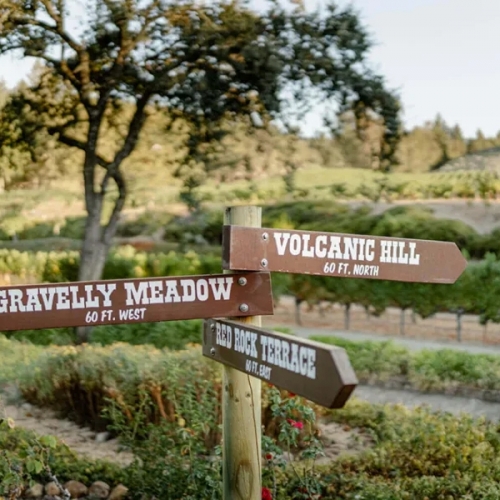
Wehmeier is head winemaker at Diamond Creek, one of the most revered of the great old Napa wineries, 20 acres (8ha) of vineyard draped like a bedspread over the dry, steepish hills of Diamond Mountain. There are three main sites: Gravelly Meadow, Volcanic Hill and Red Rock Terrace. A fourth vineyard by the lake is so tiny it barely yields a barrel of wine.
Diamond Creek’s founder, Al Brounstein, was a pioneer of singe-vineyard Cabernet Sauvignon and diligently worked to express the singular nature of each of the vineyards. His widow Boots sold the winery exactly five years ago to the Champagne house Roederer, whose owners, the Rouzaud family, were old friends.
California Pioneers
Al died in 2006; I never met him but I met Boots and her son Phil Ross many times, both in London (they were indefatigable travellers) and at the winery, where Phil would drive you around in a golf cart, the little rubber tyres crunching over the brush, up and down the inclines, past the tranquil, tree-hung lake that Al had created.
The wines have legions of fans (well, not legions – there are never more than 2,000 cases to go round). In 2019, Wine Spectator delighted in the 2016 Gravelly Meadow’s “explosive energy wrapped in a silken carpet of exquisitely fine-grained tannins.” The sepia-tinted labels, with Al Brounstein’s drawings of the vineyards, looked like old Western “Wanted” posters.
On a fine June morning I’m sitting in the tasting room at Diamond Creek with CEO Nicole Carter and Wehmeier, who is reassuring me they have no plans to update the labels. With every vintage Wehmeier is learning more about the vineyards. ”Each of the blocks has big differences in character from from top to bottom, even in Gravelly Meadow [the lowest-lying and flattest of the three vineyards], where you don’t think of a top and a bottom.”
There was an interesting experiment during the 2020 fires, when the only wine they made from Volcanic Hill was from the very top of the vineyard. “We didn’t feel it was totally representative of Volcanic Hill [which] makes you think of depth and a power and a certain tannin and a certain fruit profile. And this was more kind of ethereal, lighter, prettier.”
Vineyard evolution
And so they started thinking of microclimates. “Each of the blocks has big differences in character from from top to bottom – so it made sense to call that part of Volcanic Hill a microclimate.” From that idea comes the Three Vineyard Blend, an approachable, faultless and rather international wine that is the only really new thing that Roederer has introduced. The Brounsteins had blended the vineyards before, but as one-offs – for the Napa Valley Auction in 2013, for example. Now Carter confirms that they will do one a year.
The wine is more accessible than the single vineyard wines; the tannins are smoother, the fruit more forward. The idea is that it will showcase Diamond Mountain terroir rather than the unique properties of the individual vineyards – and of course there are sound enough reasons to produce an entry-level Diamond Creek. “The beauty of blending is that we have more options, to fine-tune, to have more silky tannins, for example,” is how Jean-Baptiste Lecaillon, CEO of Roederer Estates, puts it.
Lecaillon is in charge of the entire Roederer portfolio, from Champagne Roederer, Château Pichon Lalande and Château de Pez in Bordeaux, to Merry Edwards in Sonoma’s Russian River and half a dozen others. He visits three times a year to run through the blends with the Napa team (Pichon and de Pez winemaker and estate director Nicolas Glumineau comes out every couple of years).
Roederer’s stewardship couldn’t have come at a better time for this Napa treasure – and the wines show it. “Any vineyard property after 50 years is in need of some level of investment, Diamond Creek was at that stage,” Wehmeier emailed me. “With Al’s passing in 2006 and Boots running the property for the next 13 years the focus was on wine production and sales. Some replanting had occurred and of course, retaining old vines is what everyone strives to do. Vineyard replanting requires capital and patience and Roederer came prepared for both.”

The Roederer years
Some 20 per cent of the total vineyard has been replanted, and new equipment bought; there’s going to be a spanking new winery, date unspecified. Lecaillon says that the wines had fallen prey to the collective mania for muscular reds that gripped Napa in the 1990s and 2000s. Whether you agree with that or not, under Wehmeier, who has worked on half a dozen vintages now (he joined just before harvest 2020) the wines shine. Each is fascinatingly different – the texture and perfume of Red Rock, the power of Volcanic Hill, and cool Gravelly Meadow’s fine, structured tannins and earthy scent.
There’s obviously been some healthy debate as to style. Wehmeier says (jokingly) that Lecaillon “politely beat him up” about Volcanic Hill just after the takeover – “he thought it was non-Napa, too big, too alcoholic”. That vineyard’s 2021, a masterpiece of power, tension and restraint, is now Wehmeier’s benchmark for what Diamond Creek can do. “There’s a note in this that I’ve never figured out where it’s from. It’s not necessarily classic Volcanic Hill, a little like Northern Rhone.”
Wehmeier and his team aren’t doing anything spectacular. Extractions are gentler, macerations cooler; they’re using less new oak, lighter toasts – “You should be thinking about the vineyard, not about oak”. The French team lend a subtle guiding hand: Wehmeier says he’s “been somewhat influenced by Nicolas [Glumineau] and the Pichon philosophy, which is a very careful extraction, almost that you’d rather under-extract than over-extract.”
He wrestles constantly with the notion of “Napaness” and what character this land should give the wine. Of Red Rock Terrace he says, “I don’t want these necessarily to be Napa – I want them to be themselves,” Lecaillon notes that California pioneers like the Brounsteins were inspired by Bordeaux, and made wines in the style of the great châteaux they knew and loved. “But today, I’m not here to make Bordeaux. I’m here to make Diamond Creek.” It’s an important distinction and it gives Wehmeier free rein to work out what interpretation of the land actually means.
Whatever conclusion they come to, the team – both French and American – have just a hint of wide-eyed awe that this rare and wonderful thing should be in their charge. “It’s unique. It’s vibrant,” Lecaillon told me.”It really is like nowhere else”